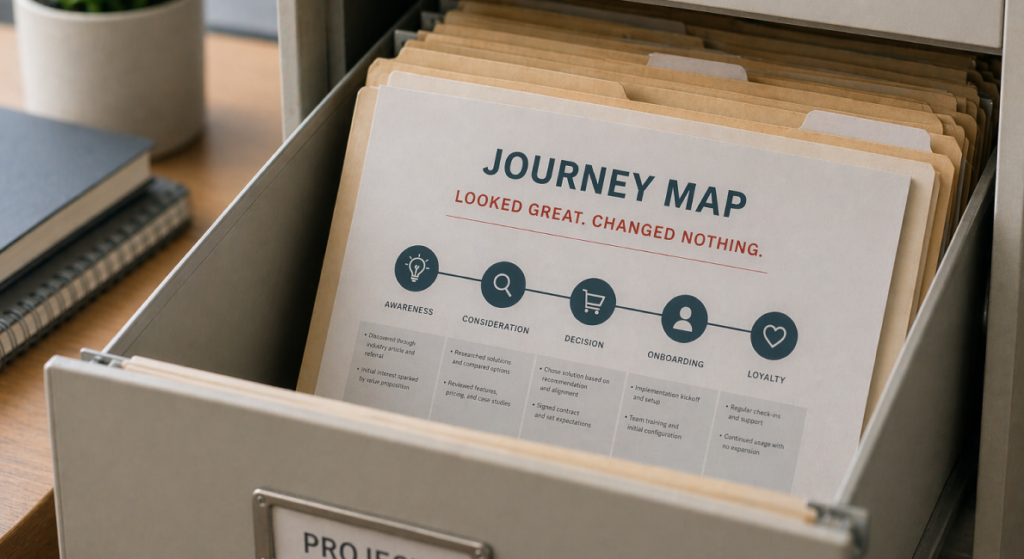
I’ve made journey maps that looked great and changed nothing.
Color-coded phases across the top. Emotional arcs dipping in all the right spots. And then… the doc got filed away and the team went back to building what they were already going to build.
That’s the trap. Journey maps feel productive. They’re visual, they’re collaborative, and they give the impression of rigor. But a journey map that no one refers back to is just a nice-looking artifact.
Here’s what I’ve changed about how I make them.
I narrow the scope aggressively. A map covering “the entire customer experience” is almost always too broad to be actionable. Now I pick one moment: first login, the first billing confusion, the first time someone hits an error state. Something specific enough that a team can say “yes, that’s the problem we’re solving.”
I anchor every step to real data. If I can’t point to a research session, a support ticket, or a quote from a user interview, that step doesn’t go on the map. Assumptions get labeled clearly as assumptions. This keeps the artifact honest and makes it easier to prioritize which gaps to close.
I build for a decision, not for documentation. Before I start, I ask: what choice does this map need to inform? A roadmap prioritization? A handoff to engineering? Scoping a discovery sprint? The answer shapes every decision about what to include and what to cut.
And I keep it short enough to actually use. If the map needs a legend and 20 minutes of context to understand, it won’t survive a meeting. One page. Real quotes. Clear problem framing. That’s it.
Journey maps aren’t deliverables. They’re thinking tools. When they work, it’s because the team can point to a specific moment on the map and say “that’s where we’re losing people.” That moment is the whole point.